
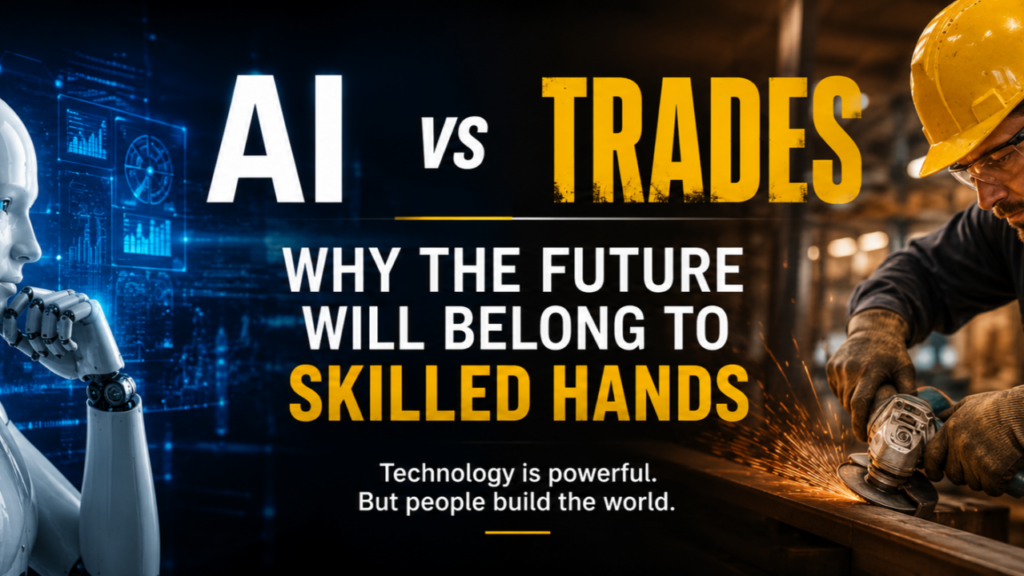
As a teenager, my parents drilled into me and my siblings the wisdom of getting a trade behind us that we could always fall back on in times of need. Each of us followed this wisdom and went onto to other careers in Education, Social Work, Agriculture and Human Resources. In more recent decades, young Australians have been told that the pathway to a successful career is through university. At the same time, trade occupations have often been portrayed as the alternative for people who are “good with their hands” rather than an equally valuable professional career.
Artificial intelligence could turn that thinking on its head and the thinking back to the future!
As AI becomes more capable of performing administrative, analytical and knowledge based work, many traditional white-collar occupations will change significantly. Yet the physical world still needs to be built, repaired, installed and maintained.
Australia still needs Electricians, Mechanical Fitters, Boilermakers, Welders, Plumbers, Diesel Mechanics, Fabricators, Machinists and other skilled tradespeople.
In fact, the AI revolution could make skilled trades more valuable, more technical and more attractive as careers.
AI Will Change the Meaning of a “Good Career”
The employment conversation around AI tends to focus on which jobs it will replace.
A better question is:
Which occupations become more valuable when AI can perform more of the routine intellectual work?
Consider the activities AI is already becoming increasingly capable of assisting with: preparing reports, analysing data, producing documents, writing computer code, processing information, answering customer enquiries and undertaking administrative tasks.
Compare that with replacing a failed bearing on a production line, diagnosing a hydraulic fault, repairing mining equipment, welding structural steel, installing electrical infrastructure or maintaining machinery in a processing plant.
AI can provide information to the worker.
It cannot easily replace the worker who has to physically diagnose the problem and make the plant operate again.
That distinction could become extremely important.
The Tradesperson of the Future Will Be Different
The opportunity isn’t about protecting trades from technology.
It is about combining trades and technology.
Imagine a mechanical fitter arriving at a breakdown and using an AI assistant that already has access to the equipment’s service history, manufacturer specifications and previous failures.
Instead of searching through manuals, the tradesperson could ask:
“What are the most likely causes of this fault based on the symptoms and previous maintenance history?”
AI could identify possible causes, retrieve drawings, recommend diagnostic steps and prepare the maintenance report.
But the fitter still applies the experience, judgement and practical skills necessary to determine what is actually wrong.
That could create an entirely new type of worker:
the AI-enabled trades professional.
Turn a Tradesperson Into a Technician, Diagnostician and Data User
This is where Australia has an enormous opportunity.
Rather than teaching apprentices that AI threatens their employment, we should teach them how to use it.
Future apprenticeships could combine traditional trade competencies with:
- AI-assisted fault finding
- predictive maintenance
- robotics and automation
- digital drawings and schematics
- sensors and condition monitoring
- computerised maintenance systems
- automated reporting
- machine diagnostics
- augmented-reality work instructions
- data interpretation
A mechanical fitter who understands machinery, hydraulics and pneumatics but can also interpret sensor data and use AI-assisted diagnostics becomes considerably more valuable than either technology or traditional trade skills alone.
The same applies to electricians, boilermakers, welders, diesel mechanics and other skilled occupations.
AI Could Remove One of the Worst Parts of Trade Work
Another reason AI could make trades more attractive is that it can remove much of the administration surrounding the actual work.
Ask many experienced tradespeople what frustrates them and paperwork will usually appear somewhere on the list.
Take 5s. Maintenance reports. Job cards. Inspection reports. Timesheets. SWMS documentation. Equipment histories. Parts requests.
AI should increasingly be able to assist workers to complete these activities through voice.
A tradesperson could finish a maintenance task and simply explain:
“Replaced the drive-end bearing on Pump 4 after identifying excessive vibration. Alignment checked and unit tested satisfactorily.”
The system could turn that conversation into the required maintenance records.
Technology therefore doesn’t necessarily replace the tradesperson.
It allows the tradesperson to spend more time being a tradesperson.
We Need to Change How Young People See Trades
There is also a marketing problem.
For too long, trades have sometimes been presented to students as the alternative to university.
That is the wrong message.
A trade should be presented as a pathway into advanced industry, technology and entrepreneurship.
The 17-year-old considering their future should be able to see a pathway such as:
Apprentice → Tradesperson → Advanced Technician → Automation Specialist → Supervisor → Project Manager → Business Owner
That is a career.
And increasingly it can be a technology career.
Instead of showing apprentices only with a spanner or welding helmet, show them working with robotics, automated manufacturing, renewable-energy infrastructure, rail systems, advanced machinery and AI-assisted diagnostics.
The perception of trades needs to catch up with the reality of modern industry.
Experience Could Become More Valuable, Not Less
AI also creates an interesting economic effect.
Technology makes information inexpensive.
Experience remains difficult to manufacture.
A person may be able to ask AI how a hydraulic system operates, but that doesn’t mean they can walk into a factory, hear a machine running incorrectly and recognise that something isn’t right.
That knowledge comes from years of exposure.
The combination of AI knowledge + human experience + practical capability could therefore become extraordinarily powerful.
An experienced tradesperson equipped with AI may effectively carry decades of technical documentation in their pocket while retaining something AI doesn’t possess: practical experience of the physical environment in front of them.
Australia Should Build the World’s Best AI-Enabled Trade Workforce
Australia talks extensively about becoming an advanced manufacturing economy, expanding renewable energy, building infrastructure and improving productivity.
None of these things happen without skilled tradespeople.
We therefore have an opportunity to rethink vocational education.
Every apprentice entering a trade should graduate not only competent in their trade but competent in using the digital tools that will define modern industry.
Employers should also be encouraged to retrain existing tradespeople.
Imagine taking a 50-year-old mechanical fitter with 30 years of industrial experience and teaching them advanced AI-assisted diagnostics.
You don’t replace 30 years of knowledge.
You amplify it.
That could create enormous productivity improvements.
The Next Generation May Choose a Trade Because of AI
There is an understandable fear that AI will eliminate employment.
But technology has always created new combinations of skills.
The future may belong disproportionately to people who can combine human judgement, physical capability and technology.
That puts skilled trades in an interesting position.
The occupation once considered less technologically sophisticated than office work could become one of the more resilient and technologically enabled career choices available.
Perhaps the question we should be asking young Australians is no longer:
“University or a trade?”
Instead, it should be:
“What combination of technology and practical skills will make you valuable for the next 30 years?”
For many people, the answer could be a trade.
AI doesn’t have to be the technology that replaces Australia’s tradespeople.
It could be the technology that makes being a tradesperson one of the most attractive careers of the next generation.